
Walnuts
The Everyday Nut That’s Good for Your Heart
Discover how walnuts, naturally rich in healthy fats and nutrients, can support a heart-conscious diet and healthy cholesterol levels.
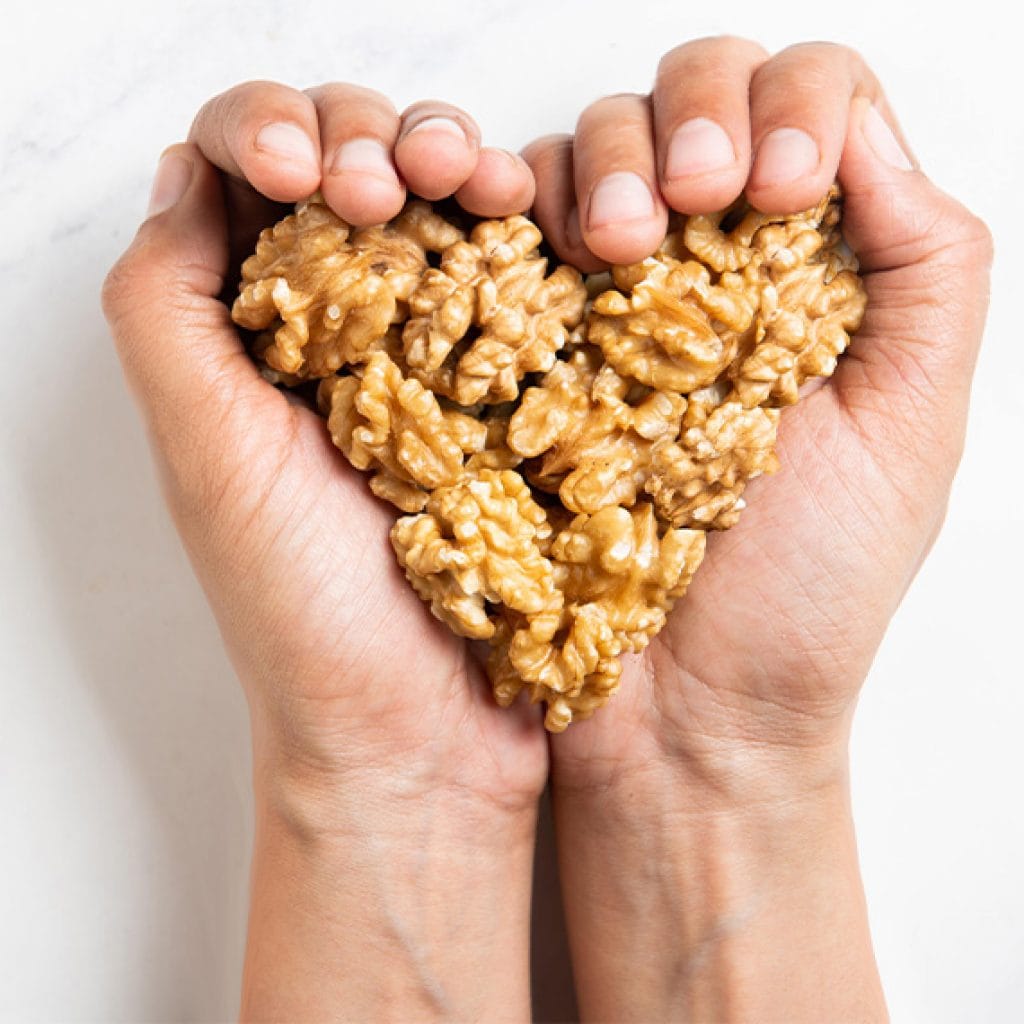
Walnuts are often described as a simple, everyday food—but their nutritional profile makes them particularly interesting when it comes to cardiovascular health.
They contain predominantly unsaturated fats, along with plant-based omega-3 fatty acid (alpha-linolenic acid, or ALA), fibre, protein, vitamins, minerals and other bioactive compounds. These characteristics are consistent with the type of foods recommended as part of a heart-healthy dietary pattern.
But what does the science actually tell us about walnuts and the heart?
What makes walnuts different?
One of the distinguishing features of walnuts is their fatty-acid composition.
Unlike foods that are high in saturated fat, walnuts are rich in polyunsaturated fats. They are also one of the few commonly eaten nuts that provide a meaningful amount of the plant-based omega-3 fatty acid ALA.
This matters because replacing foods high in saturated fat with foods containing unsaturated fats is an established part of heart-healthy dietary guidance. The American Heart Association's 2026 dietary guidance emphasises choosing sources of unsaturated fat in place of saturated fat as part of an overall cardiovascular-friendly eating pattern.
Walnuts also provide fibre, protein, vitamins, minerals and other compounds that contribute to their overall nutritional value.
Walnuts and cholesterol
One of the clearest areas of research surrounding walnuts is their effect on blood cholesterol.
A systematic review and meta-analysis published in 2018 examined 26 controlled clinical trials involving more than 1,000 participants. Compared with control diets, walnut-enriched diets were associated with modest reductions in total cholesterol and LDL cholesterol—the type of cholesterol commonly referred to as “bad” cholesterol.
More recent research has provided additional evidence.
In a two-year randomised controlled trial involving 708 healthy adults aged 63–79, participants who added walnuts to their usual diet experienced a modest reduction in LDL cholesterol compared with those who did not consume walnuts. At the end of the study, LDL cholesterol was approximately 4.3 mg/dL lower on average in the walnut group.
These findings are important, but they need to be interpreted correctly. A reduction in LDL cholesterol is a favourable change in a cardiovascular risk factor; it does not mean that eating walnuts alone prevents heart attacks or other cardiovascular events.
What about heart disease itself?
This is where it is important to distinguish between risk factors and clinical outcomes.
Research consistently supports the inclusion of nuts within healthy dietary patterns, and clinical trials have demonstrated improvements in some cardiovascular risk factors, particularly blood lipids. However, evidence from individual food interventions does not mean that walnuts should be considered a treatment for cardiovascular disease.
The American Heart Association's current guidance emphasises that cardiovascular health depends on the overall dietary pattern, rather than any single food. A heart-healthy pattern includes vegetables and fruits, whole grains, legumes, nuts, fish and other nutritious foods, while limiting saturated fat, added sugars and excess sodium.
In other words, walnuts can be one useful component of a healthy diet—not a substitute for one.
How many walnuts should you eat?
There isn't a single walnut serving that should be prescribed to everyone. Individual nutritional needs vary according to factors such as total calorie requirements, age, health status and overall diet.
For general dietary guidance, the American Heart Association describes a small handful, or about 1 ounce (28 grams) of whole nuts, as a serving size.
It's also worth remembering that walnuts are energy-dense. Eating more isn't necessarily better. A reasonable portion incorporated into an otherwise balanced diet is a more useful approach than treating walnuts as a supplement or medicine.
The way you eat them matters
Plain or unsalted walnuts are an easy addition to meals and snacks.
You can add them to:
- Oatmeal or porridge
- Yogurt
- Salads
- Whole-grain dishes
- Fruit
- Homemade snacks
- Cooked vegetables
Choosing unsalted walnuts can also help avoid unnecessary sodium. The American Heart Association recommends nuts as part of an overall dietary pattern and suggests choosing minimally processed foods and limiting sodium.
A small food with a bigger nutritional picture
Walnuts are not a miracle food, and they should not be viewed as a replacement for medical treatment or a balanced diet.
What makes them valuable is simpler: they are a nutrient-dense whole food that provides unsaturated fats, plant-based omega-3 ALA, fibre, protein and several micronutrients. Research suggests that incorporating walnuts into the diet can have favourable effects on certain cardiovascular risk factors, particularly cholesterol levels.
The broader lesson is perhaps more useful than any single claim about walnuts: heart health is built through everyday dietary patterns and habits. And sometimes, those habits can be as simple as adding a small handful of walnuts to a meal.